with the collaboration of Iranian Scientific Association for Landscape (ISAL)

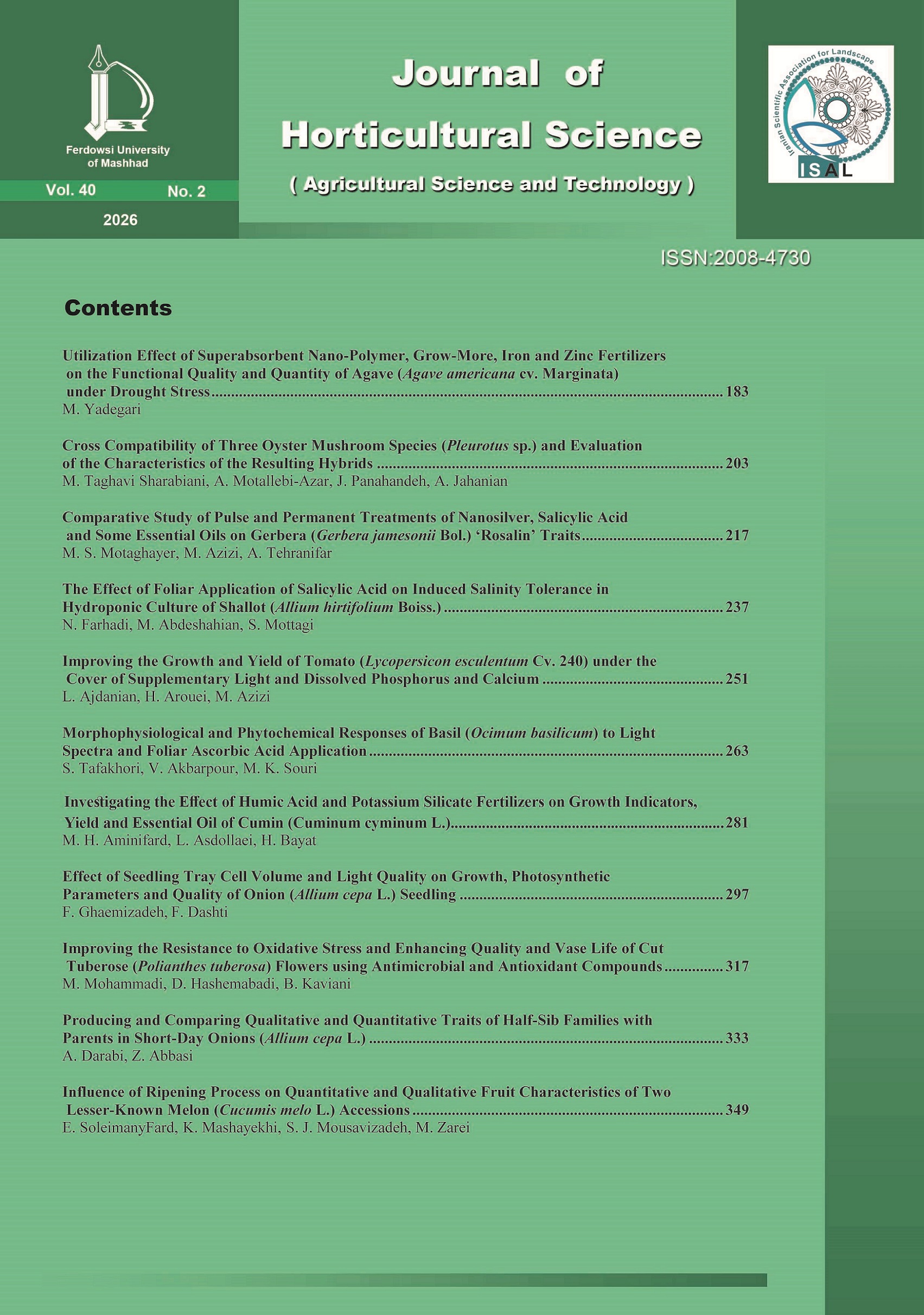
Improving the Resistance to Oxidative Stress and Enhancing Quality and Vase Life of Cut Tuberose (Polianthes tuberosa) Flowers using Antimicrobial and Antioxidant Compounds

Document Type : Research Article

Authors

Department of Horticultural Science, Ra.C., Islamic Azad University, Rasht, Iran

Abstract
Introduction
Cut tuberose flowers face challenges such as reduced vase life and postharvest quality deterioration. This problem is mainly caused by various factors such as dehydration, vascular blockage due to bacterial growth, ethylene accumulation and oxidative stress, which lead to a reduction in the postharvest lifespan of flowers. To address these challenges, the use of chemical and natural compounds has been considered an effective method to extend postharvest longevity and maintain the quality of cut flowers. Aluminum sulfate helps to preserve the freshness of cut flowers by reducing microbial growth, improving water uptake and preventing vascular blockage. The use of aluminum sulfate in vase solutions has shown to increase of the postharvest lifespan in certain cut flowers, such as roses, gardenias and lisianthus. Plant essential oils (containing phenol), possess antioxidant, antibacterial and antifungal properties. They can inhibit microbial growth in vase solutions and prevent cellular damage caused by reactive oxygen species (ROS) or free radicals. The positive effects of certain essential oils on extending the vase life of some cut flowers, including gerberas, roses and alstroemerias, have been reported. Cobalt chloride prevents vascular blockage caused by bacterial agents in stems and maintains a high-water flow rate, leading to improved water uptake by cut flowers. This salt can also extend vase life by inhibiting ethylene production, preventing its accumulation and reducing respiration. The beneficial effect of cobalt chloride on increasing the vase life of some ornamental cut flowers, including roses, carnations, tuberoses, gladiolus and chrysanthemums, has been reported. 8-Hydroxyquinoline sulfate (8-HQS) is an inhibitor of ethylene production and reduces respiration rate. In cut flowers such as dendrobium, gerbera and gladiolus, 8-HQS extended the vase life by preventing microbial growth, reducing respiration rate and enhancing water absorption. This study aimed to investigate the effects of aluminum sulfate, Eryngium spp. essential oil, cobalt chloride and 8-HQS on the postharvest longevity of cut tuberose flowers (Polianthes tuberosa).

Materials and Methods
Cut tuberose (Polianthes tuberosa) flowers were obtained from a commercial producer in Tehran Province. To standardize the stem length, all flowers were recut at a 60 cm distance under water and immediately transported to the postharvest laboratory at the Faculty of Agriculture, Islamic Azad University, Rasht Branch, to prevent dehydration. Upon arrival, the flowers were placed in distilled water to maintain hydration. For the experiment, five cut flowers were placed in each 2-liter plastic vase and then treated with specific concentrations of the experimental factors. The study was conducted based on a completely randomized block design with three replications. The effects of different concentrations of aluminum sulfate (50, 100 and 150 mg.L-1), Eryngium essential oil (10, 20 and 40%), cobalt chloride (200, 300 and 400 mg.L-1) and 8-HQS (100, 200 and 400 mg.L-1) on cut flowers parameters such as vase life, water uptake, fresh weight loss, chlorophyll content, malondialdehyde (MDA) as an indicator of lipid peroxidation, bacterial colony count and antioxidant enzyme activity were evaluated. Thus, the present experiment consisted of 12 treatments, 3 replications and 5 flower stems per replication, totaling 36 experimental units (plots). Treatments were applied permanently, with each treatment prepared based on a 500 mL volume in the plastic vase. Data were subjected to analysis of variance (ANOVA) and means were compared by the LSD at P < 0.05 using the SAS ver. 9.2 software.

Results and Discussion
The results showed that treatment with aluminum sulfate significantly increased vase life and prevented fresh weight loss. Aluminum sulfate improved water uptake and preserved chlorophyll content, thereby enhancing the longevity of the flowers. Eryngium essential oil also had a positive effect on maintaining flower quality due to its antimicrobial and antioxidant properties. Results of the variance analysis showed that treatments with aluminum sulfate, Eryngium essential oil, cobalt chloride and 8-HQS significantly increased the vase life of tuberose cut flowers (P < 0.01). The effect of treatments was significant for most traits. The longest vase life (12 and 11.50 days) was observed in aluminum sulfate at 100 and 50 mg.L-1, respectively, while the control treatment had a vase life of only 8 days. The highest water uptake was observed in treatments with aluminum sulfate (100 mg.L-1), 8-HQS (200 mg.L-1) and Eryngium essential oil (10 mg.L-1). The control treatment had the highest bacterial population at the stem base (33 CFU.mL-1) and vase solution (73 CFU.mL-1). 8-HQS (400 mg.L-1) showed the lowest bacterial population at the stem base (4 CFU.mL-1). Just some treatments were selected for measurement of enzymes activity. Among the selected treatments, Eryngium essential oil (20 mg.L-1) exhibited the highest peroxidase (POD) enzyme activity, while the control treatment (0.07 µmol.g-1 fresh weight) had the lowest. The control treatment (9.47 µmol.g-1 fresh weight/min) showed the highest catalase (CAT) enzyme activity, while cobalt chloride (300 mg.L-1, 1.84 µmol/g fresh weight.min-1) had the lowest. Aluminum sulfate can partially reduce ethylene production and respiration rate in cut flowers. It primarily acts as an antimicrobial agent, indirectly extending vase life. Some studies suggest aluminum may moderately reduce lipid peroxidation in cell membranes. The aluminum ion may interact with cell walls, enhancing tissue rigidity and delaying wilting. Studies on roses, peonies and gladiolus confirmed that aluminum sulfate delays senescence by inhibiting microbial growth, preventing bacterial blockage and improving water uptake. Plant essential oils (e.g., in tuberose, chrysanthemum, gerbera, gladiolus and carnation) extend postharvest life due to their antimicrobial and antioxidant properties, reducing microbial load in vase solutions and ethylene production. 8-HQS, as a disinfectant, extended vase life in peonies, dendrobium and gladiolus by inhibiting bacteria, enhancing water uptake, delaying senescence, suppressing ethylene and reducing respiration rate. Increased POD activity in treated flowers indicates enhanced antioxidant defense, crucial for neutralizing free radicals and mitigating oxidative stress. Reduced CAT activity in treated tuberose flowers may result from lower ROS production, direct inhibition of enzyme activity, hormonal/metabolic signaling changes and delayed oxidative stress and senescence.

Conclusion
These findings suggest that the use of these compounds particularly aluminum sulfate at the concentration of 100 and 50 mg.L-1 can be an effective method to improve the postharvest longevity and quality of cut tuberose flowers.

Keywords

Subjects

Authors retain the copyright. This is an open access article distributed under Creative Commons Attribution 4.0 International License (CC BY 4.0).


1.     Abey, H. (1984). Catalase in vitro. Methods of Enzymology, 105, 121-126. https://doi.org/10.1016/S0076-6879(84)05016-3
2.     Aslmoshtaghi, E., Jafari, M., & Rahemi, M. (2014). Effects of daffodil flowers and cobalt chloride on vase life of cut rose. Journal of Chemical Health Risks, 4(2), 1-6.
3.    Babarabie, M., Zarei, H., & Varasteh, F. (2015). The effect of rosemary essential oils and thymol on vase life and some physiological characteristics of alstroemeria cut flowers. International Journal of Agriculture and Bioscience, 4(3), 122-126.
4.    Babarabie, M., Zarei, H., & Varasteh, F. (2016). Potential of increasing the vase life and improvement of some physiological characteristics of Alstroemeria cut flowers by using non-harmful compounds environmentally. Journal of Chemical Health Risks, 6(1), 1-8.
5.     Banjaw, D. T., Lemma, D. T., & Megersa, H. G. (2017). Review on effect of essential oil on vase life of cut flowers. Journal of Biology, Agriculture and Healthcare, 7(11), 25-28.
6.     Basiri, Y., Zarei, H., Mashayekhy, K., & Pahlavany, M. H. (2011). Effect of rosemary extract on vase life and some qualitative characteristics of cut carnation flowers (Dianthus caryophyllus cv. ‘White Librity’). Journal of Stored Products and Postharvest Research, 2(14), 261-265.
7.     Bayat, H., Azizi, M., Shoor, M., & Mardani, H. (2011). Effect of ethanol and essential oils on extending vase-life of carnation cut flower (Dianthus caryophyllus cv. ‘Yellow Candy’). Notulae Scientia Biologicae, 3(4), 100-104. https://doi.org/10.15835/nsb346266
8.     Bayat, H., Geimadil, R., & Abdollahi Saadabad, A. (2013). Treatment with essential oils extends the vase life of cut flowers of lisianthus (Eustoma grandiflorum). Journal of Medicinal Plants and By-products, 2, 163-169. https://doi.org/10.22092/jmpb.2013.108590
9.     Bidarigh, S. (2015). Improvement vase life of chrysanthemum (Dendranthema grandiflorum L.) cut flowers using essential oils of geranium, eucalyptus and myrtus. Journal of Ornamental Plants, 5(4), 213-221.
10.  Bradford, M. M. (1976). A rapid and sensetive method for the quantitation of microgram guantities of protein utilizing the principle of protein-dyebinding. Analytical Biochemisitry, 72, 248-254. https://doi.org/10.1016/0003-2697(76)90527-3
11.  Çelikel, F. G., Reid, M. S., & Jiang, C. Z. (2020). Postharvest physiology of cut Gardenia jasminoides flowers. Scientia Horticulturae, 261, 108983. https://doi.org/10.1016/j.scienta.2019.108983
12.  Dareini, H., Abdosi, V., & Danaee, E. (2014). Effect of some essential oils on postharvest quality and vase life of gerbera cut flowers. European Journal of Experimental Biology, 4(3), 276-280.
13.  Dung, C. D., Seaton, K., & Singh, Z. (2017). Influence of type and concentration of sugars, supplemented with 8-hydroxyquinoline sulphate, on the vase life of waxflower. Folia Horticulturae, 29(1), 39-49. https://doi.org/10.1515/fhort-2017-0005
14.  El-Sayed, I. M., & El-Ziat, R. A. (2021). Utilization of environmentally friendly essential oils on enhancing the postharvest characteristics of Chrysanthemum morifolium Ramat cut flowers. Heliyon, 7, e05909. https://doi.org/10.1016/j.heliyon.2021.e05909
15.  Fan, K. C., Xu, J., Khaldun, A. B. M., Chen, Y., Chen, L., & Yan, X. (2022). Physiological effects induced by aluminium and fluoride stress in tall fescue (Festuca arundinacea Schreb). Ecotoxicology and Environmental Safety, 231, 113192. https://doi.org/10.1016/j.ecoenv.2022.113192
16.  Farokhzad, A. R., Khalighi, A., Mostofi, Y., & Naderi, R. (2008). Effect of some chemical treatments on quality and vase life of lisianthus (Eustoma grandiflora) cut flowers. Acta Horticulturae, 768, 479-486. https://doi.org/10.17660/ActaHortic.2008.768.64
17.  Giannopolitis, C., & Ries, S. (1997). Superoxid desmutase. I: Occurence in higher plant. Plant Physiology, 59, 309-314. https://doi.org/10.1104/pp.59.2.309
18.Hashemabadi, D. (2006). Evaluation of the effect of 1-MCP on vase life of cut carnation cv. ‘Tempo’ flower. Ph.D. Thesis, Islamic Azad University, Science and Research Branch, Tehran, Iran, 131 p. (In Persian)
19.  Hashemabadi, D., Abedini-Aboksari, H., Sedaghathoor, S., & Kaviani, B. (2016). Geranium (Pelargonium graveolens) extract and mechanical treatment improve water relation, enzyme activity and longevity of cut chrysanthemum (Dendranthema grandiflorum (Ramat.) Kitamura) flowers. Acta Scientiarum Polonurum Hortorum Cultus, 15(5), 185-203.
20.  Hashemi, M., Mirdehghan, S. H., & Farahmand, H. (2013). The effects of thymol, menthol and eugenol on quality and vase-life of chrysanthemum cut flowers. Iran Agricultural Research, 32(2), 55-70. https://doi.org/10.22099/iar.2014.2005
21.  Hassanpour Asil, M., Hatamzadeh, A., & Nakhai, F. (2004). Study on the effect of temperature and various chemical treatments to increase vase life of cut rose flower “Baccara”. Agricultural Sience Research Journal of Guilan Agriculture Faculty, 1(4), 121-129. (In Persian)
22.  Heath, R. L., & Parker, L. (1968). Photoperoxidation in isolated chloroplasts: I. Kinetics and stiochiometry of fatty acid peroxidation. Archive of Biochemistry and Biophysics, 125, 189-198. https://doi.org/10.1016/0003-9861(68)90654-1
23.  Hegazi, M. A., & Gan, E. (2009). Influences of some essential oils on the vase-life of Gladiolus hybrida L. spikes. International Journal for Agro Veterinary and Medical Science, 3, 19-24. https://doi.org/10.5455/ijavms.20101124115729
24.  Hosseini, N., Akbari, M., Ghafarzadegan, R., Changizi Ashtiyani, S., & Shahmohammadi, R. (2012). Total phenol, antioxidant and antibacterial activity of the essential oil and extracts of Ferulago angulata spp. Angulata. Journal of Medicinal Plants, 11(43), 80-89. https://dor.isc.ac/dor/20.1001.1.2717204.2012.11.43.9.9
25.  Ichimura, K., Taguchi, M., & Norikoshi, R. (2006). Extension of the vase life in cut roses by treatment with glucose, isothiazolinonic germicide, citric acid and aluminum sulphate solution. Japan Agrictural Research Quarterly, 40, 263-269. https://doi.org/10.6090/jarq.40.263
26.  Jamali, B., & Rahemi, M. (2011). Carnation flowers senescence as influenced by nickel, cobalt and silicon. Journal of Biological and Environmental Sciences, 5(15), 147-152.
27.  Kiamohammadi, M., Golchin, A., & Hashemabadi, D. (2010). The effects of different floral preservative solutions on keeping quality of cut lisianthus (Eustoma grandiflorum). Acta Horticulturae, 877, 1749-1755. https://doi.org/10.17660/ActaHortic.2010.877.240
28.  Li, W., Ullah, S., Xu, Y., Bai, T., Ye, S., Jiang, W., & Yang, M. (2022). Effects of elevated aluminum concentration and distribution on root damage, cell wall polysaccharides, and nutrient uptake in different tolerant Eucalyptus clones. International Journal of Molecular Science, 23, 13438. https://doi.org/10.3390/ijms232113438
29.  Liao, L. J., Lin, Y. H., Huang, K. L., & Chen, W. Sh. (2001). Vase life of Eustoma grandiflorum as affected by aluminum sulfate. Botanical Bulletin of Academia Sinica, 42, 35-38.
30.  Liu, J., He, S., Zhang, Z., Cao, J., Lv, P., He, S., Cheng, G., & Joyce, D. C. (2009). Nano-silver pulse treatments inhibit stem-end bacteria on cut gerbera cv. Ruikou flowers. Postharvest Biology and Technology, 54(1), 59-62. https://doi.org/10.1016/j.postharvbio.2009.05.004
31.  Manfredini, M. G., Paiva, P. D. O., Almeida, E. F. A. A., Nascimento, A. M. P., Sales, T. S. S., & Santos, L. O. (2017). Postharvest quality of essential oil treated roses. Ornamental Horticulture, 23(2), 192-199. http://dx.doi.org/10.14295/oh.v23i2.993
32.  Mazumdar, B. C., & Majumder, K. (2003) Methods on Physcochemical Analysis of Fruits. University College of Agriculture, Calcutta University. 187 p.
33.  Mohammadi, M., Hashemabadi, D., & Kaviani, B. (2012). Effect of cobalt chloride on vase life and post-harvest quality of cut tuberose (Polianthes tuberosa L.). European Journal of Experimental Biology, 2(6), 2130-2133.
34.  Mohammadi, R., & Hashemabadi, D. (2016). Improvement postharvest longevity of alstroemeria (Alstroemeria hybrida) by sucrose, honey and citric acid. Plant Ecophysiology, 204-218. (In Persian).
35.Mousavi Bazaz, A., & Tehranifar, A. (2011). Effect of ethanol, methanol and essential oils as novel agents to improve vase-life of Alstroemeria flowers. Journal of Biology and Environmental Science, 5(14), 41-46.
36.  Murali, T. P., & Reddy, T. V. (1993). Postharvest life of gladiolus as influenced by sucrose and metal salts. Acta Horticulturae, 343, 313-320. https://doi.org/10.17660/ActaHortic.1993.343.76
37.  Nabigol, A., Naderi, R., Babalar, M., & Kafi, M. (2006). The effect of some chemical treatments and cold storage on the vase life of chrysanthemum (Chrysanthemum morifolium). Iranian Journal of Agricultural Sciences, 37(4), 801-809. (In Persian)
38.  Nahrabadi, L. K., Rood, N., Danyaei, A., Babarabie, M., & Shadbash, M. (2015). The effect of Eucalyptus and Rosa damascena essences with sucrose on vase life and physiological characteristics of cut Gerbera cv. ‘Alain Ducasse’. Journal of Ornamental Plants, 5(4), 205-212.
39.  Nermeen, S. T., Emara, Kh. S., & Olfat, B. S. (2010). Prolonging vase life of carnation flowers using natural essential oils and its impact on microbial profile of vase solutions. Australian Journal of Basic and Applied Sciences, 4(8), 3559-3574.
40.  Nguyen, T., & Ha, S. (2024). The potential postharvest treatments to delay flower senescence and improve Botrytis resistance in cut peony flowers. Horticulturae, 10, 1352. https://doi.org/10.3390/horticulturae10121352
41.  Nguyen, T. K., & Lim, J. H. (2021). Do eco-friendly floral preservative solutions prolong vase life better than chemical solutions? Horticulturae, 7, 415. https://doi.org/10.3390/horticulturae7100415
42.  Norouzi Khatibi, M., Hashemabadi, D., & Shafiei, M. R. (2012). Improvement of vase life and postharvest quality of cut chrysanthemum (Dendranthema grandiflorum L.) flower using Eryngium essential oil. 3th Congress on Agricultural Science and Food Industries, Fasa, Iran. (In Persian)
43.  Pourianejad, F., Hasanzadeh, N., & Kalatejarei, S. (2014). The effect of herbal essential oil in preservative solution, on quantitative, vase life, bacteria-induced stem xylem blockage of lisianthus var. Echo. Agrivita Journal of Agricultural Science, 36(2), 174-181. http://dx.doi.org/10.17503/Agrivita-2014-36-2-p174-181
44.  Put, H. M. C., Clerkx, A. C. M., & Boekestein, A. (1992). Aluminium sulphate restricts migration of Bacillus subtilis in xylem of cut roses: A scanning electron microscope study. Scientia Horticulturae, 51(3-4), 261-274. https://doi.org/10.1016/0304-4238(92)90124-U
45.  Rabiza-Swider, J., Skutnik, E., J˛edrzejuk, A., & Rochala-Wojciechowska, J. (2020). Nanosilver and sucrose delay the senescence of cut snapdragon flowers. Postharvest Biology and Technology, 165, 111165. https://doi.org/10.1016/j.postharvbio.2020.111165
46.  Saini, R. S., Yamdaqni, R., & Sharma, S. K. (1994). Effect of some chemicals on keeping quality and vase life of tuberose (Polianthes tuberosa L.) cut flowers. Pakistan Journal of Society Science, 42, 376-378.
47.  Sardoei, A. S., Mohammadi, G. A., & Shahdadneghad, M. (2014). Interaction effect of temperature and thyme essential oil on vase life of cut narcissus flowers. European Journal of Experimental Biology, 4(2), 82-87.
48.  Seyf, M., Khalighi, A., Mostofi, Y., & Naderi, R. (2012). Effect of sodium nitroprusside on vase life and postharvest quality of a cut rose cultivar (Rosa hybrida ‘Utopia’). Journal of Agricultural Science, 4, 174-181. https://doi.org/10.5539/jas.v4n12p174
49.  Solgi, M. (2018). The application of new environmentally friendly compounds on postharvest characteristics of cut carnation (Dianthus caryophyllus L.). Brazilian Journal of Botany, 41(3), 515-522. https://doi.org/10.1007/s40415-018-0464-x
50.  Solgi, M., Kafi, M. T., Taghavi, S., & Naderi, R. (2009). Essential oils and silver nanoparticles (SNP) as novel agents to extend vase-life of gerbera (Gerbera jamesonii cv. ‘Dune’) flowers. Postharvest Biology and Technology, 53, 155-158. https://doi.org/10.1016/j.postharvbio.2009.04.003
Send comment about this article
Enter Name.
Enter a valid email address.
Enter a vaid affiliation.
Enter comments (At leaset 10 words)
CAPTCHA Image
Enter Security Code Correctly.
Volume 40, Issue 2
Summer 2026
Pages 332-317

  • Receive Date 14 June 2025
  • Revise Date 09 September 2025
  • Accept Date 11 October 2025
  • First Publish Date 11 October 2025