با همکاری انجمن علمی منظر ایران

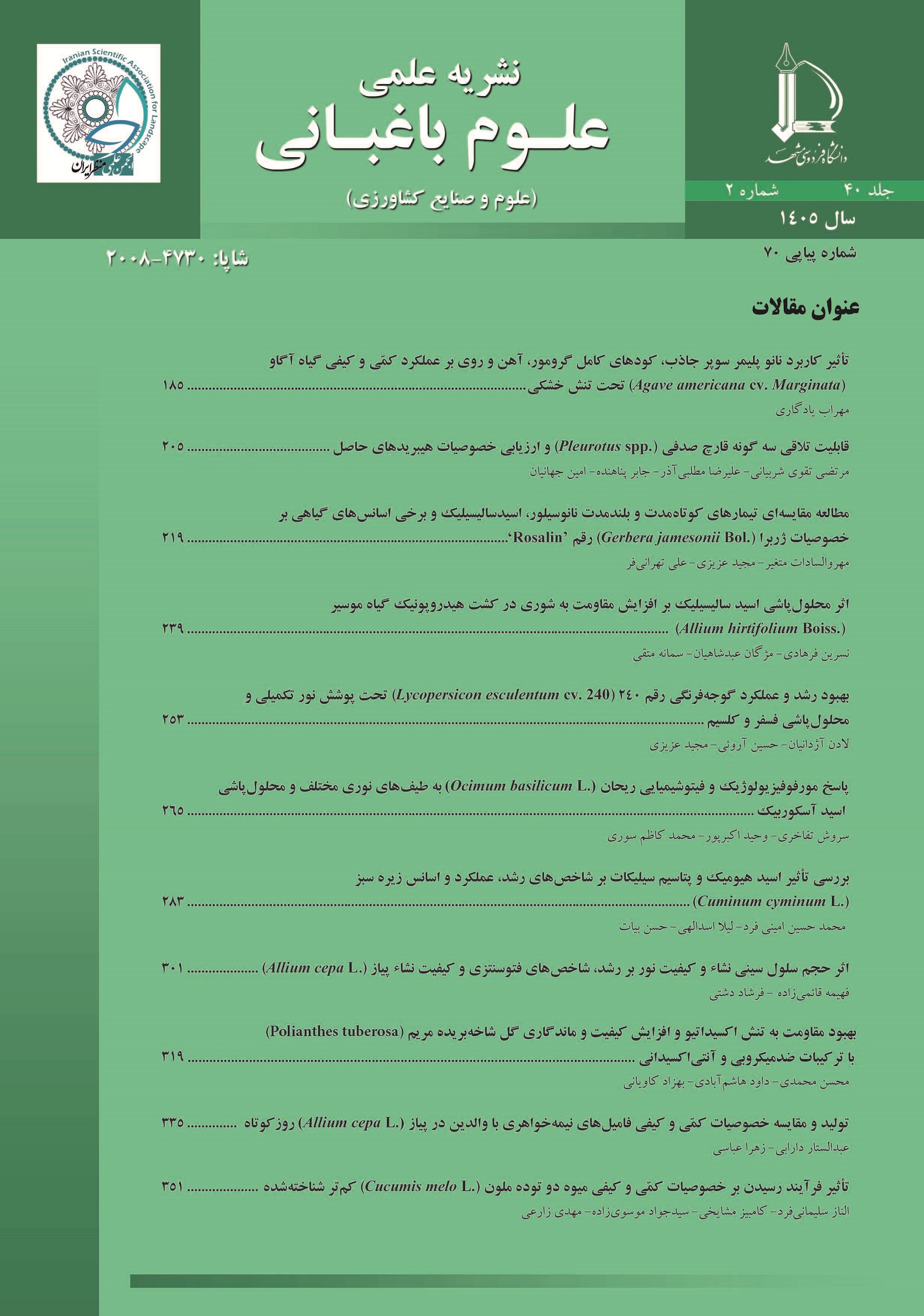
تأثیر کاربرد نانو پلیمر سوپر جاذب، کودهای کامل گرومور، آهن و روی بر عملکرد کمّی و کیفی گیاه آگاو (Agave americana cv. Marginata) تحت تنش خشکی

نوع مقاله : مقالات پژوهشی

نویسنده

مرکز تحقیقات تغذیه و محصولات ارگانیک، واحد شهرکرد، دانشگاه آزاد اسلامی، شهرکرد، ایران

چکیده
با توجه به ارزشمندی گیاه آگاو آمریکانا رقم ’مارجیناتا‘ (Agave americana cv. Marginata) از خانواده آگاواسه در صنایع مختلف غذایی و دارویی، پژوهش حاضر به‌صورت طرح کرت‌های دوبار خرد‌شده در قالب بلوک‌های کامل تصادفی با سه تکرار در گلخانه دانشگاه آزاد اسلامی شهرکرد در سال‌های 140۳-140۲ انجام شد. در این تحقیق، سطوح تنش خشکی (میزان تبخیر از تشت تبخیر کلاس A در سه سطح ظرفیت مزرعه (D1)، 50 درصد (D2) و 75 درصد تخلیه رطوبتی (D3))به‌عنوان کرت­های اصلی، سطوح پلیمر سوپر جاذب (استفاده (S1) و عدم استفاده (S2)) در کرت‌های فرعی و 15 ترکیب محلول‌پاشی (کودهای گرومور1 (F1)، گرومور2 (F2)، گرومور3 (F3)، لیبفر آهن (F4)، لیبفر روی (F5)، گرومور1 + لیبفر آهن (F6)، گرومور1 + لیبفر روی (F7)، گرومور2 + لیبفر آهن (F8)، گرومور2 + لیبفر روی (F9)، گرومور3 + لیبفر آهن (F10)، گرومور3 + لیبفر روی (F11)، گرومور1 + لیبفر آهن + لیبفر روی (F12)، گرومور2 + لیبفر آهن + لیبفر روی (F13)، گرومور3 + لیبفر آهن + لیبفر روی (F14)، شاهد (عدم استفاده از تیمارهای مغذی-F15) ) در کرت‌های فرعی فرعی قرار گرفتند. پس از رسیدن گیاهان به مرحله شش الی هشت برگی، در شش مرحله با فواصل 14 روزه، تیمارهای مغذی به‌صورت محلول‌پاشی برگی اضافه گردید. صفات ریخت‌شناختی (وزن تر و خشک ریشه و برگ، ضخامت و طول برگ)، صفات فیزیولوژیکی (کلروفیل کل و مقادیر عناصر روی، آهن و نیتروژن ساختارهای برگ و ریشه) و صفات فیتوشیمیایی (هکوژنین، ساپونین، پروتئین برگ و ریشه) مورد بررسی قرار گرفتند. نتایج به‌دست‌آمده نشان‌دهنده اثرگذاری معنی‌دار تیمارهای مورد استفاده بر صفات مورد ارزیابی بود. افزودن کودها به‌ویژه کود گرومور1 (20-20-20) به همراه محلول‌پاشی ریزمغذی آهن و روی منجر به افزایش بیشترین مقادیر در اکثر صفات مورد بررسی شد. بیشترین مقادیر وزن خشک برگ (11/30 گرم در گیاه)، وزن خشک ریشه (82/3 گرم در گیاه)، کلروفیل کل (82/2 میلی‌گرم در گرم وزن تر)، هکوژنین (48/35 میلی‌گرم در کیلوگرم وزن تر) و ساپونین (86/66164 میلی‌گرم در کیلوگرم وزن تر) اغلب در تیمار D1S1F12 به دست آمد، هرچند که در برخی موارد با تیمارهای D1S1F14 و D2S1F14 تفاوت معنی‌داری نداشت. کمترین مقادیر صفات مورفوفیزیولوژیکی و فیتوشیمیایی در گیاهان تحت تیمار تنش خشکی شدید-عدم کاربرد پلیمر سوپر جاذب و عدم تیمار مغذی (D3S2F15) تولید شدند. با توجه به نتایج حاصل از این تحقیق، می‌توان کود کامل گرومور (NPK) با ترکیب 20-20-20 را به‌عنوان مؤثرترین تیمار برای افزایش صفات مورد ارزیابی گیاه آگاو، از جمله مقادیر هکوژنین و ساپونین تحت شرایط گلخانه‌ای برای تحقیقات آینده پیشنهاد نمود.

کلیدواژه‌ها

موضوعات

عنوان مقاله English

Utilization Effect of Superabsorbent Nano-Polymer, Grow-More, Iron and Zinc Fertilizers on the Functional Quality and Quantity of Agave (Agave americana cv. Marginata) under Drought Stress

نویسنده English

M. Yadegari
Research Center of Nutrition and Organic Products, Shahrekord Branch, Islamic Azad University, Shahrekord, Iran
چکیده English

Introduction
Agave americana cv. Marginata from the Agavaceae family is an important plant with many uses in various medicinal and food industries. Among environmental stresses, water deficit stress plays an important role in the biosynthesis of secondary metabolites in medicinal plants in arid and semi-arid regions like Iran. Drought stress has detrimental effects on growth and yield and can disrupt the balance between the antioxidant defense system and free radicals by triggering a cascade of biochemical reactions in which free radicals cause cell damage. In sustainable production systems of medicinal and aromatic plants, stable quantitative and qualitative functions can be achieved under conditions of environmental stress and it is possible to improve the production of secondary metabolites in these plants under adverse environmental conditions. Therefore, this study was done to evaluate some of the important macro-micro nutrients on the morpho-physiological and phytochemical properties of Agave americana cv. Marginata to determine and introduce the best combinations of fertilizers with use of superabsorbent nano-polymer under water stress conditions.
 
Materials and Methods
This research used a randomized complete block design (RCBD) in a split-split plot layout with three replications. Irrigation regimes (D1-D3: Field Capacity, 50% and 75% evaporation from basin class A) in main plots, superabsorbent nano-polymer application (S1-S2: use and not use) in sub plots and treatments of fertilizers [F1-F15: grow-more 1 (F1), grow-more 2 (F2), grow-more 3 (F3), iron chelate (F4), zinc chelate (F5), grow-more 1 + iron chelate (F6), grow-more 1 + zinc chelate (F7), grow-more 2 + iron chelate (F8), grow-more 2 + zinc chelate (F9), grow-more 3 + iron chelate (F10), grow-more 3 + zinc chelate (F11), grow-more 1 + iron chelate + zinc chelate (F12), grow-more 2 + iron chelate + zinc chelate (F13), grow-more 3 + iron chelate + zinc chelate (F14) and control (F15)] in sub-sub plots were done. This research was performed in greenhouse conditions of Islamic Azad University Branch of Shahrekord (latitude: 32°20′ N, longitude: 50°51′ E, altitude: 2061 m) in 2023-2024. In each year, fertilizer treatments were applied in foliar application after stage of V8 (plants had 8 leaves) in 6 stage by 14 days interval and harvesting was done one month after the final application of fertilizers. The fertilizers Grow-More (NPK), iron and zinc in 4 gr.l-1 concentration by the production company certification were used in V8 stage in plants and the effects were compared with control plants. Weed control was done manually during the entire experiment. During the experiment, no systemic pesticide or herbicide was used. The harvested shoots were transferred to the laboratory for measurement of various characteristics. Morphological characters such as leaf length, leaf diameter and dry/fresh root/leaf weight; physiological characters such as total chlorophyll and zinc, iron and nitrogen content in root/leaf and phytochemical characters such as contents of hecogenin, saponin, and protein in leaf and root were measured. For assessment of the total chlorophyll content of A.americana, the leaves were extracted with 80% acetone. The absorbance of the extraction was read at 470, 648, and 664 nm, and the content of total chlorophyll was calculated as mg per g leaf fresh weight. For the measurement of hecogenin, saponin, total protein in the leaf and root and the nitrogen content in leaf and root use the protocols of Hackman et al., 2006, Sidana et al., 2016, Bradford, 1976; Álvarez-Chávez et al., 2021; were followed respectively.
 
Results and Discussion
Over two consecutive years, the obtained results showed that the use of treatments increased the characters and showed significant effectiveness. The highest mean values for leaf dry weight (30.11 g.plant-1), leaf fresh weight (207.33 g.plant-1), root dry weight (3.82 g.plant-1), root fresh weight (18.79 g.plant-1), length of leaf (64.55 cm), leaf diameter (0.41 Cm), total chlorophyll (2.82 mg.g-1 fresh weight), hecogenin (35.48 mg.kg-1 fresh weight), saponin (66164.8 mg.kg-1 fresh weight), nitrogen of leaf (1.39 mg.g-1 dry weight), nitrogen of root (1.23 mg.g-1 dry weight), protein of leaf (25.34 mg.g-1 dry weight), protein of root (16.99 mg.g-1 dry weight), zinc of leaf (68.99 µg.g-1 dry weight), zinc of root (44.84 µg.g-1 dry weight), iron of leaf (81.01 µg.g-1 dry weight) and iron of root (49.84 µg.g-1 dry weight) made in grow-more fertilizers specially grow-more 1 (20-20-20) in combination with Fe/Zn Libfer. However the superabsorbent nano-polymer application had an aggressive effect on the amounts of characters especially in hardness of water stress. The lowest values for morpho-physiological and phytochemical characters such as leaf dry weight (12.81 g.plant-1), leaf fresh weight (89.54 g.plant-1), root dry weight (1.62 g.plant-1), root fresh weight (8.18 g.plant-1), length of leaf (41.12 cm), leaf diameter (0.24 cm), total chlorophyll (1.95 mg.g-1 fresh weight), hecogenin (21.88 mg.kg-1 fresh weight), saponin (22134.3 mg.kg-1 fresh weight), nitrogen of leaf (0.29 mg.g-1 dry weight), nitrogen of root (0.77 mg.g-1 dry weight), protein of leaf (10.11 mg.g-1 dry weight), protein of root (6.47 mg.g-1 dry weight), zinc of leaf (34.34 µg.g-1 dry weight), zinc of root (20.36 µg.g-1 dry weight), iron of leaf (43.77 µg.g-1 dry weight) and iron of root (27.73 µg.g-1 dry weight) made in control plants. In most of the measured characters the treatments of D1S1F12, D3S1F14 and D2S1F14 were the best and control plants had the least of the characters.
 
Conclusion
Generally the application of Grow-More fertilizer 1 (20-20-20) with the consumption of zinc and iron fertilizers can be a good strategy to improve the morpho-physiological and phytochemical characters of Agave americana cv. Marginata especially the hecogenin and saponin amounts in water stress conditions. However the use of superabsorbent nano-polymer in strenuous drought stress (75%) is more effective than other water stress levels.
 

کلیدواژه‌ها English

Grow-more fertilizer
Hecogenin
Medicinal plant
Saponin

Authors retain the copyright. This is an open access article distributed under Creative Commons Attribution 4.0 International License (CC BY 4.0).

  1. Aghaei, K., Ghasemi Pirbalouti, A., Mousavi, A., Naghdi Badi, H. A., & Mehnatkesh A. M. (2022). Effects of different fertilizers and the foliar application of L-phenylalanine on mineral contents of hyssop [Hyssopus officinalis subsp. angustifolius (Bieb.)]. Journal of Horticultural Plants Nutrition, 4(2), 13-28. (In Persian). https://doi.org/10.22070/hpn.2021.4639.1038
  2. Albergaria, E. T., Oliveira, A. F., & Albuquerque, U. P. (2020). The effect of water deficit stress on the composition of phenolic compounds in medicinal plants. South African Journal of Botany, 131, 12-17. http://dx.doi.org/10.1016/j.sajb.2020.02.002
  3. Alizadeh, A., Moghaddam, M., Asgharzade, A., & Mahmoodi Sourestani, M., (2020). Phytochemical and physiological response of Satureja hortensis to different irrigation regimes and chitosan application. Industrial Crops and Products, 158, 112990. https://doi.org/10.1016/j.indcrop.2020.112990
  4. Almrani, H. A. (2019). Effect of chemical fertilizers (NPK) in the growth two species of henbane and total alkaloids content. Iraq Journal of Agriculture, 24(1), 52-61.
  5. Álvarez-Chávez, J., Villamiel, M., Santos-Zea, L., & Ramírez-Jiménez, A. K. (2021). Agave by-products: An overview of their nutraceutical value, current applications, and processing methods. Polysaccharides, 2, 720-743. https://doi.org/10.3390/polysaccharides2030044
  6. Amissah, J. N., Alorvor, F. E., Okorley, B. A., Asare, C. M., Osei-Safo, D., Appiah-Opong, R., & Addae-Mensah, I. (2022). Mineral fertilization influences the growth, cryptolepine yield, and bioefficacy of Cryptolepis sanguinolenta (Lindl.) Schlt. Plants, 11(1), 122. https://doi.org/10.3390/plants11010122
  7. Arnon, D. I. (1975). Physiological principles of dry land crop production. In: U.S. Gupta (Ed.) Physiological Aspects of Dry Land Farming, 3-14. Oxford Press.
  8. Asgarian, M., Aminifard, M. H., Khayat, M., & Jahani, M. (2019). Evaluation of different level of complete fertilizer NPK and folic acid on morphological properties, yield and yield components of Ocimum basilicum Journal of Agroecology, 11, 1375-1388. (In Persian). https://doi.org/10.22067/jag.v11i4.73422
  9. Askary, M., Behdani, M. A., Parsa, S., Mahmoodi, S., & Jamialahmadi, M. (2018). Water stress and manure application affect the quantity and quality of essential oil of Thymus daenensis and Thymus vulgaris. Industrial Crops and Products, 111, 336-344. https://doi.org/10.1016/j.indcrop.2017.09.056
  10. Babaei, Kh., Moghaddam, M., & Farhadi, N. (2021). Morphological, physiological and phytochemical responses of Mexican marigold (Tagetes minuta ) to drought stress. Scientia Horticulturae, 284, 110-116. http://dx.doi.org/10.1016/j.scienta.2021.110116
  11. Babalar, M., Mohtashami, S., Tabrizi, L., & Roushan, V. (2020). Effect of ammonioum sulfat on yield properties and phytochemical properties of savory (Satureja hortensis Saturn). Journal of Horticultural Science, 51, 273-286. (In Persian). https://doi.org/10.22059/ijhs.2018.265743.1511
  12. Bagherifard, A., Hamidoghli, Y., HasanBeiglouei, M., & Orang Ghaedi, M. (2020). Effects of drought stress and superabsorbent polymer on morpho-physiological and biochemical traits of caper (Capparis spinosa). Australian Journal of Crop Science, 14, 13-20. http://dx.doi.org/10.21475/ajcs.20.14.01.p1418
  13. Bani Taba, A., Yadegari, M., & Naderi Darfaghshahi, M. R. . (2025). The biochemical properties of Satureja species affected by micronutrients, genotype, and locations in drought stress conditions. Journal of the Saudi Society of Agricultural Sciences, 24, 82. https://doi.org/10.1007/s44447-025-00105-9
  14. Beiranvandi, M., Akbari, N., Ahmadi, A., Momivand, H., & Nazarian F. (2020). Interaction of biochar and superabsorbent on the composition of Satureja rechingeri Jamzad essential oil under drought stress. Iranian Journal of Medicinal and Aromatic Plants Research, 36, 780-793. (In Persian). https://doi.org/10.22092/ijmapr.2020.342067.2732
  15. Bharathi, T. U., Lallawmzuali, R., & Kirthishree, S. P. (2024). Diversity in flower morphology of the single-type tuberose (Agave amica ). Genetic Resources and Crop Evolution, 71, 4239-4254. https://doi.org/10.1007/s10722-024-01906-7
  16. Bradford, M. M. (1976). A rapid and sensitive method for the quantitation of microgram quantities of protein utilizing the principle of protein-dye binding. Anals of Biochemistry, 72, 248-250. https://doi.org/10.1006/abio.1976.9999
  17. Caser, M., Chitarra, W., Angiolillod, F., & Perrone, I. (2019). Drought stress adaptation modulates plant secondary metabolite production in Salvia dolomitica Industrial Crops and Products, 129, 85-96. https://doi.org/10.1016/j.indcrop.2018.11.068
  18. Danesh-Shahraki, H., Ghasemi Pirbalouti, A., & Rajabzadeh, F. (2023). Water deficit stress mitigation by the foliar spraying of salicylic acid and proline on the volatile oils and growth features of hyssop (Hyssopus officinalis). Journal of Essential Oil-Bearing Plants, 26, 115-129. https://doi.org/10.1080/0972060X.2022.2160279
  19. Dere, S., Güneş, T., & Sivaci, R. (1998). Spectrophotometric determination of chlorophyll-A, B and total carotenoid contents of some algae species using different solvents. Turkish Journal of Botany, 22(1), 13-18.
  20. Esch, E. H., Lipson, D. A., & Cleland, E. E. (2019). Invasion and drought alter phenological sensitivity and synergistically lower ecosystem production. Ecology, 100, 34-45.‏ https://doi.org/10.1002/ecy.2802
  21. Fariaszewska, A., Aper, J., Van Huylenbroeck, J., & De Swaef, T. (2020). Physiological and biochemical responses of forage grass varieties to mild drought stress under field conditions. International Journal of Plant Production, 14, 335-353. https://doi.org/10.1007/s42106-020-00088-3
  22. Fathi, B., Reezi, S., Rouhi, V., & Ghobadi Neya, M. (2017). Effect of different levels of superabsorbent and vermicompost on qualitative and quantitative traits of gazania (Gazania hybrida) in green roof condition. Journal of Horticultural Science, 48, 423-429. (In Persian). https://doi.org/10.22059/ijhs.2017.206858.1011
  23. García-Villalba, W. G.,Rodríguez-Herrera, R., Ochoa-Martínez, L. A., Quiñones, O. M., López, M. G., Gallegos-Infante, J. A., & Quiñones, G. B. (2023). Comparative study of four extraction methods of fructans (agavins) from Agave durangensis: Heat treatment, ultrasound, microwave and simultaneous ultrasound-microwave. Food Chemistry, 415, 135767. https://doi.org/10.1016/j.foodchem.2023.135767
  24. Gustafson, A. F. (2010). Handbook of Fertilizers- Their Sources, Make-up, Effects and Use. Read Books. 325 p.
  25. Hackman, D. A., Giese, N., Markowitz, J. S., McLean, J., Ottariano, S. J., Tonelli, C., Weissner, W., Welch, S., & Catherine, U. (2006). Agave (Agave americana). Journal of Herbal Pharmacotherapy, 6(2), 101-122.
  26. Hamedi, B., Ghasemi Pirbalouti, A., & Rajabzadeh, F. (2022). Responses to morpho-physiological, phytochemical, and nutritional characteristics of Damask Rose (Rosa damescena) to the applied of organic and chemical fertilizers. Communications in Soil Science and Plant Analysis, 53(17), 1-17. https://doi.org/10.1080/00103624.2022.2070634
  27. Han, R. C., Xu, Z. R., Li, C. Y., Rasheed, A., Pan, X. H., Shi, Q. H. & Wu, Z. M. (2022). The removal of nitrate reductase phosphorylation enhances tolerance to ammonium nitrogen deficiency in rice. Journal of Integrative Agriculture, 21(3), 631-643. http://dx.doi.org/10.1016/S2095-3119(20)63473-6
  28. Hayati, A., Rahimi, M. M., Kelidari, A., & Hosseini, S. M. (2021). Effects of humic acid and iron nanochelate on osmolytes content of black cumin (Nigella sativa) under drought stress conditions. Journal of Medicinal and Aromatic Plants Research, 37(5), 809-821. (In Persian). https://doi.org/10.22092/ijmapr.2021.354715.2995
  29. Hoseini, A., Heidari, H., Nosrati, A., & Khorami Vafa, M. (2020). Investigating effect of water-superabsorbent polymer on growth and leaf relative water content in foxtail millet (Setaria italica) under drought condition. Crop Science Research in Arid Regions, 2, 231-240. (In Persian). https://doi.org/10.22034/csrar.2021.269609.1083
  30. Javadi, H., Mousavi, Gh., Seghatoleslami, M. J., & Kermani, F. (2021). Effect of organic and chemical improvers application on yield and essential oil percentage of dill (Anethum graveolens) under water deficit stress conditions. Plant Productions, 44, 283-294. (In Persian). https://doi.org/10.22055/ppd.2019.30621.1806
  31. Jokar, A., Sateei, A., Ebadi, M., & Ahmadi Gelsefidi, M. (2021). Effect of some nitrogen fertilizers on yield, alkaloeid content and physiological properties in Agave americana Marginata under greenhouse condition. Journal of Plant Environmental Physiology, 16, 111-126. (In Persian).
  32. Khorasani, H., Rajabzadeh, F., Mozafari, H., & Ghasemi Pirbalouti, A. (2023). Water deficit stress impairment of morphophysiological and phytochemical traits of stevia (Stevia rebaudiana Bertoni) buffered by humic acid application. South African Journal of Botany, 154, 365-371. http://dx.doi.org/10.1016/j.sajb.2023.01.030
  33. Kulak, M. (2020). Recurrent drought stress effects on essential oil profile of Lamiaceae plants: An approach regarding stress memory. Industrial Crops and Products, 154, 1-17. http://dx.doi.org/10.1016/j.indcrop.2020.112695
  34. Mahmodi, A., Yadegari, M., & Hamedi, B. (2020). Effect of vermi-compost, nitrogen and phosphorus fertilizers on morphological and phytochemical properties of Mentha piperita Journal of Plant Environmental Physiology, 15, 84-99. (In Persian).
  35. Malakoti, M. J., & Davodi, M. H. (2002). Zn Forgotten Nutrient in Life Cycle of Plant. Sana Issuance, 209 p. (In Persian).
  36. Marschner, H. (1995). Mineral Nutrition of Higher Plants. 2nd San Diego: Academic Press. pp. 379-396.
  37. Mashahiri, Y., Hasanpour Asil, M., Khaledian, M., & Farhangi, M. (2023). Effect of superabsorbent polymer and potassium silicate on morphophysiological and biochemical characteristics of daffodil (Narcissus tazetta cv. Shahla) flower under irrigation regimes. Iranian Journal of Hourticultural Science and Technology, 24, 485-502. (In Persian). http://journal-irshs.ir/article-1-619-en.html
  38. Mumivand, H., Ebrahimi, A., Morshedloo, M. R., & Shayganfar, A. (2021). Water deficit stress changes in drug yield, antioxidant enzymes activity and essential oil quality and quantity of tarragon (Artemisia dracunculus). Industrial Crops and Products, 164, 113381. https://doi.org/10.1016/j.indcrop.2021.113381
  39. Nasiri, Y., Shekari, F., & Asadi, M. (2020). Effect of biofertilizer and zinc sulphate on some morphological characters, yield and essential oil of Satureja hortensis Iranian Journal of Medicinal and Aromatic Plants Research, 36, 523-541. (In Persian). https://doi.org/10.22092/ijmapr.2020.341271.2685
  40. Pirzad, A., Darvishzadeh, R., & Hasani, A. (2017). Seed yield and essential oil responses of cumin to different irrigation regimes and super absorbent levels in Urmia climatic conditions. Crop Science Research in Arid Regions, 1, 1-12. (In Persian). https://doi.org/10.22034/csrar.01.01.01
  41. Rezaee, Z., & RafeolHoseini, M. (2017). Physiological response of Foeniculum vulgare to manuare fertilizer and superabsorbent under drought stress. Ecophysiology of Crop Science, 43, 547-564. https://sanad.iau.ir/Journal/jcep/Article/956799/FullText
  42. Ryan, J., Estefan, G., & Rashid, A. (2001). Soil and Plant Analysis Laboratory Manual. 2nd Available from ICARDA, Aleppo, Syria.
  43. Sasani, N., Pâques, L. E., Boulanger, G., & Singh, A. P. (2021). Physiological and anatomical responses to drought stress differ between two larch species and their hybrid. Trees, 35, 1467- https://doi.org/10.1007/s00468-021-02129-4
  44. Sidana, J., Singh, B., & Sharma, P. (2016). Saponins of Agave: Chemistry and bioactivity. Journal of Phytochemistry, 130, 22-46. https://doi.org/10.1016/j.phytochem.2016.06.010
  45. Thakur, M., & Kumar, R. (2020). Foliar application of plant growth regulators modulates the productivity and chemical profile of Damask rose (Rosa damascena ) under mid hill conditions of the western Himalaya. Industrial Crop Products, 158, 113024. https://doi.org/10.1016/j.indcrop.2020.113024
  46. Trejo, L., Soriano, D., Romano-Grande, E., Sánchez-Carmona, B., & Dávila-Navarro, D. E. (2023). Diversity of reproductive characters, seed set, and viability of Agave seeds used for pulque production and their wild relatives in Tlaxcala, Mexico. Genetic Resources and Crop Evolution, 71, 2877-2903. https://doi.org/10.1007/s10722-023-01803-5
  47. Wibowo, S. T. (2007). Kandungan Hormone IAA, Serpan Hara, Dan Pertumbuhan Beberapa Tanaman Budidaya Sebagia Respon Terhadap Aplikasi Pupuk Biologi Bogor: Sekolah Pascasarjana, Institut Pertanian Bogor. 432 pp.
  48. Yadegari, M. (2022a). The effects of foliar application of some micronutrient elements on the content and composition of the essential oil of Damask rose (Rosa damascena ). Iran Agricultural Research, 41(2), 35-49. https://doi.org/10.22099/iar.2022.42152.1467
  49. Yadegari, M. (2022b). Effects of NPK, botamisol, and humic acid on morphophysiological traits and essential oil of three Satureja species under drought stress. Iranian Journal of Medicinal and Aromatic Plants Research, 38(1), 61-80. (In Persian). https://doi.org/10.22092/ijmapr.2022.356264.3073
  50. Yadegari, M. (2022c). Effects of NPK, botamisol, and humic acid on morphophysiological traits and essential oil of three Thymus species under drought stress. Iranian Journal of Medicinal and Aromatic Plants Research, 2, 301-321. (In Persian). https://doi.org/10.22092/ijmapr.2022.357303.3119
  51. Yadegari, M. (2024a). The effects of foliar application of some important micronutrient elements on essential oil content and components of Dracocephalum kotschyi Journal of Horticulture and Postharvest Research, 7(1), 81-98. https://doi.org/10.22077/jhpr.2024.7079.1351
  52. Yadegari, M. (2024b). Effects of some biological and chemical fertilizers on morphophysiological characters and essential oil in Rosa damascena Mill. in drought stress. Journal of Plant Process and Function, 12, 417-440. (In Persian). https://doi.org/10.22034/12.57.417
ارسال نظر در مورد این مقاله
نام را وارد کنید.
نشانی پست الکترونیکی را به درستی وارد کنید.
وابستگی سازمانی را به درستی وارد کنید.
توضیحات را وارد کنید (حداقل 50 حرف)
CAPTCHA Image
شناسه امنیتی را به درستی وارد کنید.
دوره 40، شماره 2
تابستان 1405
صفحه 203-183

  • تاریخ دریافت 29 مهر 1403
  • تاریخ بازنگری 11 آذر 1403
  • تاریخ پذیرش 03 دی 1403
  • تاریخ اولین انتشار 03 دی 1403